

The Night Suite
Five musical novels of the night, Op. 20 to 24: water lilies on a lake at dusk, crimson flashes above the storms, the last whisper of a snowflake. Composed entirely in the mind and recorded on Albus, his Bechstein.

Music born in the night, between the stars above the Dolomites and the keys of a Bechstein Concert Grand.
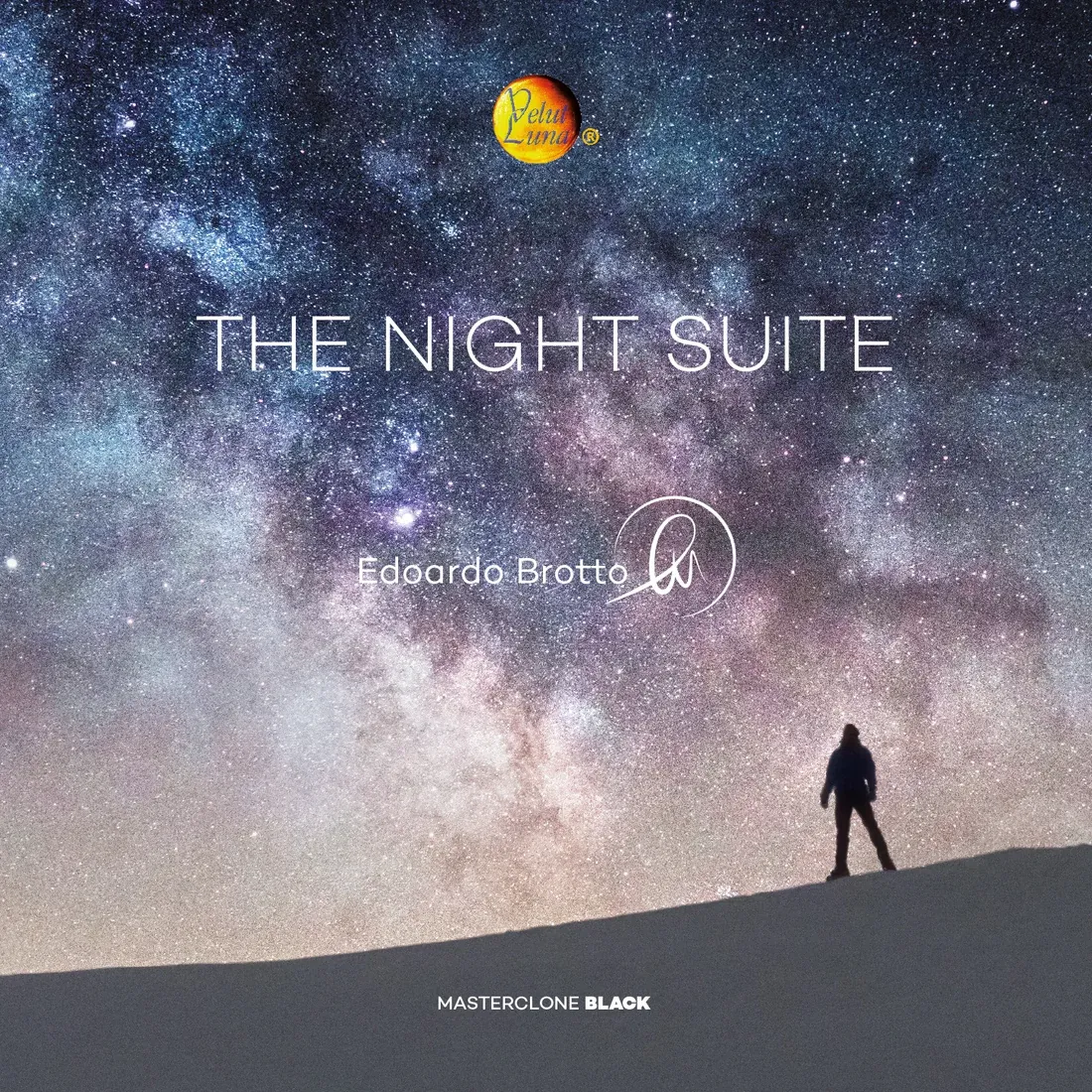
A journey through the night in five movements: water lilies on a lake at dusk, crimson flashes dancing above the storms, bells tolling under the northern sky, the last whisper of a snowflake, a dance of shadows. And through it all, like a memory that keeps returning, a waltz.
“This cycle of musical novels tells a single story, or perhaps a thousand.”
From the booklet“His snowflakes are destined to remain in the history of music.”
Massimo Crispi, Gli Stati Generali
“A recording that can rightly be considered a reference among the best solo piano productions of all time.”
Marco Lincetto, Velut Luna
Velut Luna, 2025
Jeux d'eau. Gaspard De La Nuit. La Valse.
After his own night, the night of Gaspard. Edoardo is preparing an album dedicated to Maurice Ravel: the shimmering water of Jeux d'eau, the three nocturnal visions of Gaspard De La Nuit and the dizzying whirl of La Valse, in his own arrangement for solo piano.
Every piece begins with an image or a pure musical intuition: a lake at dusk, a falling snowflake, the scent of a winter wind. From that initial spark, the ideas begin to emerge, some as brief as a harmonic progression, others as vast as an entire movement.
Edoardo holds them all in his memory, arranging them like the tiles of a mosaic. He shifts them, turns them over, and recombines them in endlessly new ways until, as if gazing down from a mountain summit, he can perceive the complete structure and choose its most beautiful form.
Only when this mental architecture is complete, with every note precisely in its place, does the music finally reach the keys of his Bechstein. His creative process is extraordinary in its execution: no score exists, nor has one ever been written. Each work lives entirely within his mind until the moment it is committed to the recording.
He describes these moments as a state of complete immersion, almost a dialogue with a pure source of knowledge.
Read the storyThe music that lives in the mindFive musical novels of the night, Op. 20 to 24: water lilies on a lake at dusk, crimson flashes above the storms, the last whisper of a snowflake. Composed entirely in the mind and recorded on Albus, his Bechstein.
Twelve sound-paintings by Rachmaninov, his musical soulmate, recorded for the 150th anniversary of the composer's birth. The first album born on Albus, his Bechstein.
Single, Op. 18, Concert Étude in B major
A concert étude for solo piano in which virtuosity turns into storytelling: dense textures, deep lyricism and the late Romantic breath of Rachmaninov.
Six original works in homage to Rachmaninov, inspired by beauty in every form: a landscape, a face, the scent of winter wind.
The debut album: seven original pieces between enchantment and dazzling virtuosity.
“A fund of imagination in a musical vernacular that is immediately appealing.”
Leslie Howard
| The Night Suite | ||
| Op. 24 | Dance of Shadows | in C sharp minor |
| Op. 23 | Snowflake's Last Whisper | in C sharp minor |
| Op. 22 | Tolls of the Northern Sky | in B major |
| Op. 21 | Red Sprites | in F sharp minor |
| Op. 20 | Water Lilies | in E major |
| Single works | ||
| Op. 19 | Waltz of the Unseen Beauty | in F minor |
| Op. 18 | Forgiveness - Concert Étude | in B major |
| Within & Without | ||
| Op. 16 | Gloomy Sparks | in E flat minor |
| Op. 14 | The Devil in Love | in B flat minor |
| Op. 12 | Dusk Spirits | in A minor |
| Op. 11 | Waltz of the Fairies | in F sharp minor |
| Op. 10 | Siberian Blizzard | in E flat minor |
| Op. 9 | Farewell my Dreams | in G major |
| Landscapes | ||
| Op. 8 | Fantasia quasi Sonata | in F minor |
| Op. 6 | Game of Thrones Variations | in D minor |
| Op. 5/3 | Summer Rain | in A major |
| Op. 5/2 | The Magical Wood | in G major |
| Op. 5/1 | Prelude in C | in C major |
| Op. 4 | Valse-Scherzo | in C sharp minor |
| Op. 3 | Devil's Dance | in G minor |
Countless nights spent high among the Alpine peaks, keeping vigil until the Milky Way arches over the silent spires of the Dolomites. The solitude of dawns breaking through mountain storms; the raw, windswept coasts of Ireland, Scotland, and northern Spain; and beneath it all, the quiet, enduring rhythm of life at high altitudes.
Finalist at the Sony World Photography Awards 2011. Exhibited at Somerset House, London, and Kinneksbond, Luxembourg.
Read the storyKeeping watch for the Milky Way
Edoardo Brotto is a pianist, composer and photographer. In his work, music and images grow from the same source: the nights spent under the Milky Way in the Dolomites return as sound in his compositions. Reserved and distant from conventional circuits, he favours the intimacy of sound over the clamour of the stage. For him, the piano is an instrument of inner exploration, a sound laboratory where form and intuition meet.
His compositions are musical novels: each one follows a single story, from its first idea to its last echo, in a late-Romantic and Impressionist language that he has made unmistakably his own. From his debut album to The Night Suite, his catalogue now reaches Op. 24. Massimo Crispi of Gli Stati Generali described him as “a young, energetic, super-virtuoso and seductive artist”; Leslie Howard heard in his first album “a fund of imagination in a musical vernacular that is immediately appealing.”
As a pianist, he is drawn to the summits of the late Romantic and twentieth-century repertoire. His recording of Rachmaninov’s Études-Tableaux, made on Albus, his Bechstein concert grand, is used by Aleksandar Madžar as a reference for his students. His improvisations in the style of the great composers have also reached an international audience: since 2017, Classic FM has featured them several times, calling them “absolutely stunning” and describing his Fantasia quasi Sonata as “a musical dialog for the ages.”
As a photographer, he spends his nights high in the Alps and on the windswept coasts of Ireland, Scotland and northern Spain, waiting for the Milky Way to rise or for the first light after a storm. A finalist at the Sony World Photography Awards in 2011, he has been published in Discover Magazine and Slate, where astronomer Phil Plait called his Crown of the Dolomites “breathtaking,” and in Italian photography magazines including the issue of Progresso Fotografico dedicated to the masters of mountain photography, alongside names such as Vittorio Sella. His work also appears in Dolomiti Photo, the book dedicated to the great photographers of the Dolomites, and has been exhibited at Somerset House in London and Kinneksbond in Luxembourg.
Edoardo Brotto graduated in piano from the Conservatorio Arrigo Pedrollo in Vicenza (a ten-year course of study) and went on to earn a Master of Music at the Koninklijk Conservatorium Brussels, a master's degree in Engineering from the University of Padua and an Executive Master in Artificial Intelligence. Under contract with Velut Luna since 2017, he has brought his engineering expertise into the realm of sound, taking full control of the quality of his recordings: since his third album he has been the sound engineer of all his own productions. Today he also works as Chief AI Officer for an engineering and architecture firm.
His art is rooted in the interplay between sound and light, a synthesis that invites the listener to discover the hidden connections between music and image, emotion and landscape.


